Named AI-tool purchases in the House remain above 2025 levels
October 12, 2026
House Statement of Disbursements through June 30, 2026.
House records show $45,409.33 in purchases naming specific AI tools in Q2 2026, 80.6% above the same quarter a year earlier. This series does not capture the full cost of enterprise AI through Microsoft and Google.
The House has purchased 6,000 Microsoft Copilot licenses for Member, committee, leadership and institutional offices, according to the Committee on House Administration. We could not isolate their cost in the expenditure files. These records therefore cannot establish total House AI spending or vendors’ shares of that total.
The new quarter adds 316 matched transaction rows. Across the first half of 2026, named-product spending reached $116,394.20, compared with $45,361.92 in the first half of 2025—about 2.6 times as much.
Microsoft, Google and enterprise AI
Microsoft: Rows naming Microsoft total $1,005,004.95 in the first half of 2026. Most appear in Q1, including $995,131.84 in three Chief Administrative Officer entries for services, software and maintenance. None identifies Copilot. Copilot’s contract cost remains unknown in this analysis.
Google: Q2 rows naming Google total $175,503.69, of which $136,399.18 is advertising and $23,821.12 is labeled Workspace or G Suite. Google began including Gemini features in Workspace Business and Enterprise plans in January 2025. Workspace spending therefore belongs in the AI discussion, but these rows do not identify the House offices’ editions, enabled features or AI-specific costs. Google One and Cloud labels also do not establish Gemini purchases or use.
| Broad platform purchases, by reported label | Q1 2026 | Q2 2026 |
|---|---|---|
| Microsoft: all labeled purchases | $1,004,909.80 | $95.15 |
| Google: Workspace / G Suite | $31,484.45 | $23,821.12 |
| Google: advertising | $162,225.23 | $136,399.18 |
| Google: other labeled purchases | $15,236.38 | $15,283.39 |
These are broad platform amounts, not AI spending totals, and exclude reseller purchases that do not name Microsoft or Google. The Google groups are mutually exclusive; “other” includes Google One, Cloud, YouTube and Nest. Download the platform transactions to inspect the labels and sources.
The new quarter in context
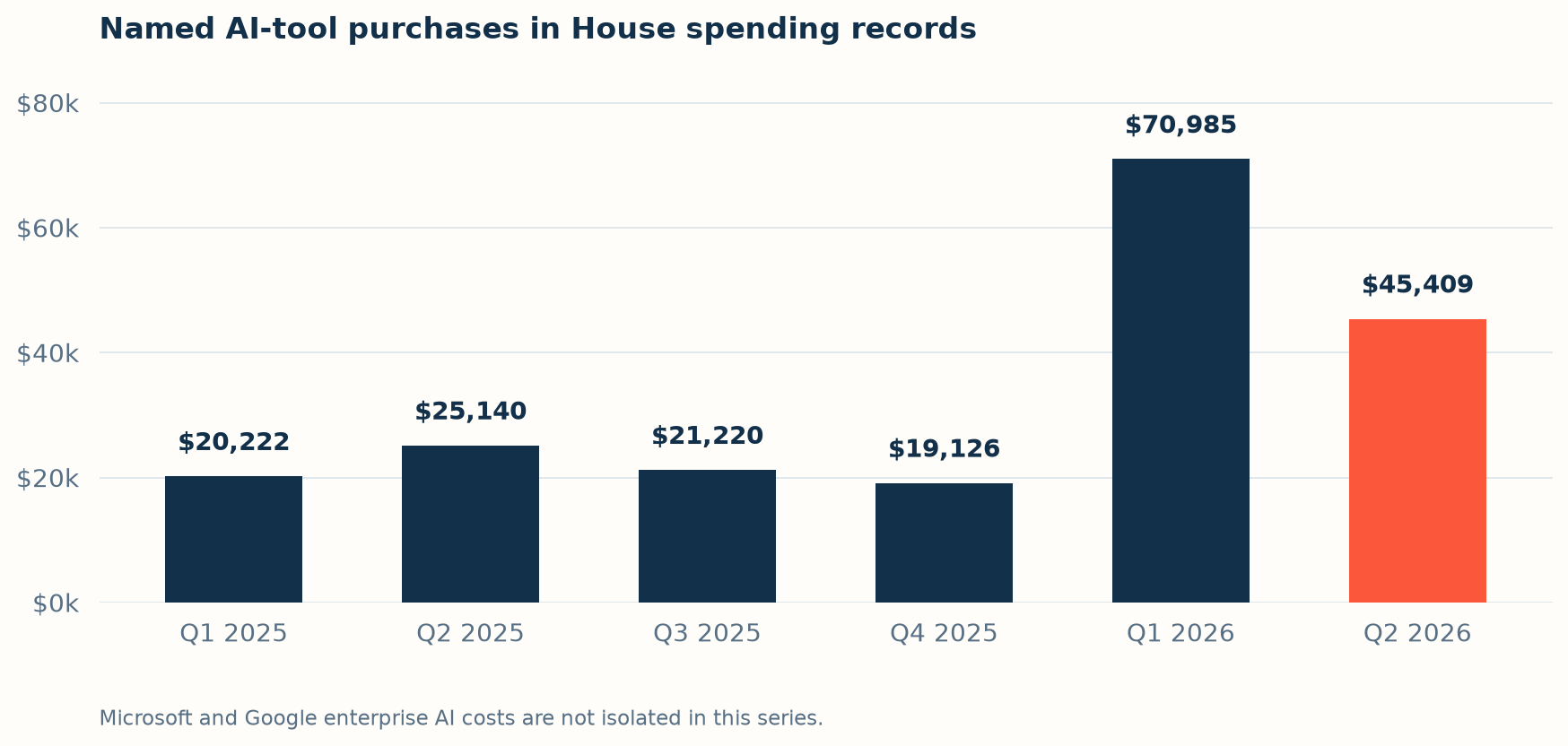
| Publication quarter | Net matched spending | Transaction rows |
|---|---|---|
| Jan-Mar 2025 | $20,222.21 | 159 |
| Apr-Jun 2025 | $25,139.71 | 232 |
| Jul-Sep 2025 | $21,219.70 | 266 |
| Oct-Dec 2025 | $19,126.39 | 174 |
| Jan-Mar 2026 | $70,984.87 | 309 |
| Apr-Jun 2026 | $45,409.33 | 316 |
The six-quarter total for named AI tools is $202,102.21 across 1,456 rows. Q2 spending was 36.0% below Q1’s $70,984.87 spike. The five quarters covered in our June report reproduce exactly; this update adds April–June 2026 using the same named-product categories.
OpenAI leads the named-product series; Claude spending grows
OpenAI / ChatGPT accounts for $28,178.77, or 62.1% of Q2’s matched spending. Anthropic / Claude rises to $9,070.12, up 30.8% from Q1. Its matched transaction count rises from 15 to 47.
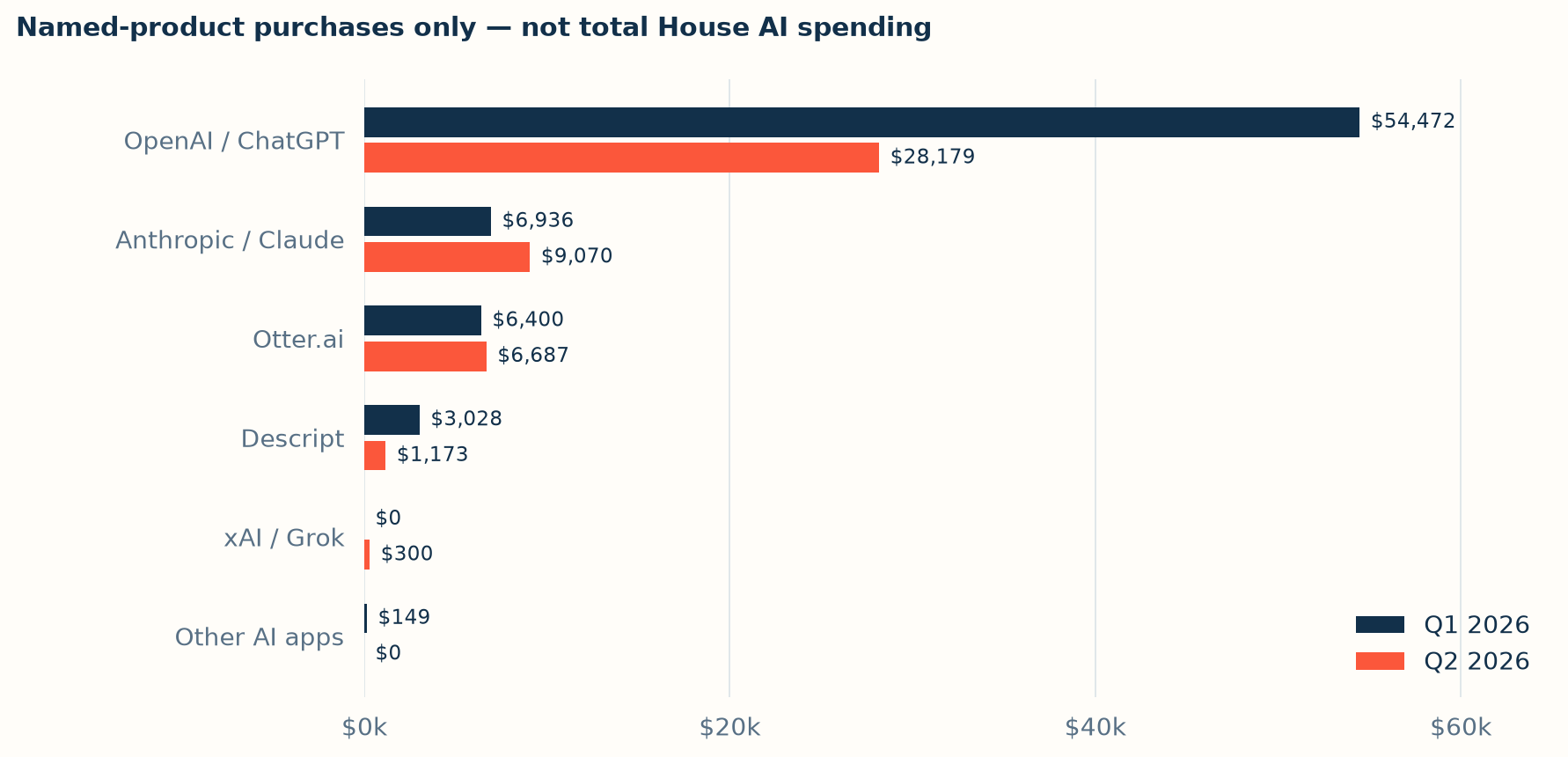
| Product category | Q1 2026 | Q2 2026 | Q2 rows |
|---|---|---|---|
| OpenAI / ChatGPT | $54,472.46 | $28,178.77 | 225 |
| Anthropic / Claude | $6,935.82 | $9,070.12 | 47 |
| Otter.ai | $6,399.86 | $6,686.95 | 29 |
| Descript | $3,027.73 | $1,173.49 | 14 |
| xAI / Grok | $0.00 | $300.00 | 1 |
| Other AI apps | $149.00 | $0.00 | 0 |
Member offices account for most named-product purchases
Member offices account for $29,142.28, or 64.2% of the Q2 total. Committees account for $8,533.53. Office groups come from reported organization names.
| Office group | Q2 2026 net spending |
|---|---|
| Member offices | $29,142.28 |
| Committees | $8,533.53 |
| Institutional | $5,103.43 |
| Leadership | $2,524.09 |
| Other House offices | $106.00 |
Why a lower quarter does not establish less use
Some charges cover a year of service. For example, a $3,360.00 Anthropic / Claude Team charge in Rep. Marc Veasey’s office lists a service period of May 20, 2026 through May 20, 2027. A $3,270.48 OpenAI / ChatGPT charge in Rep. Nick Begich’s office lists April 24, 2026 through April 24, 2027. Both appear in the Q2 source file.
Q2 also contains a $254.27 negative Otter.ai entry. We retain it: $45,663.60 in positive entries less $254.27 produces the reported $45,409.33 net total. Billing timing, annual payments and adjustments can move spending between quarters without an equivalent change in use.
Sources and method
POPVOX scanned all 730,751 detail rows in the six official House Statement of Disbursements files, matching named AI products in vendor names and descriptions. Payroll and benefit rows and publisher subtotals are excluded from AI matches. Signed amounts are summed in cents. Each row stays in its publication quarter, even when transaction or service dates fall elsewhere.
The categories cover OpenAI / ChatGPT, Anthropic / Claude, Otter.ai, Descript, xAI / Grok, and the June report’s selected other tools. A generic .ai suffix is not enough. One ambiguous $29 OpenArt label remains outside the comparison series, as it was in June. Broad Microsoft and Google purchases are reported separately without assigning a share to AI. Free access, bundled features, centralized procurement and differently labeled purchases may be missing. Transaction counts do not measure users, seats or frequency of use.
The House’s latest listed release was April–June 2026 when checked on October 12. Q3 was not yet listed. The House publishes quarterly reports within 60 days of quarter-end. This update covers the House; it makes no new finding about Senate spending.
Download matched transactions · Download summary and matching rules · Explore House spending
The transaction download preserves reported organization and vendor identifiers, document numbers, amounts, dates and source locators. A vendor ID can identify a card intermediary rather than the AI provider. File hashes in the summary identify the saved source versions.